Getting Connected to Everyone Everywhere in the World

How connected are you? If you’re like me, you might often feel you’re too connected and should probably just step away from the phone, smart phone, computer, tablet device, etc., etc… and take a nice long technology-free walk.

But I also have no desire to give up these ever-increasing connections. I get to chat with people all over the planet instantly. I can browse news from journalists far and wide, and sometimes find out things even before the networks in the U.S. catch on. And I can watch videos, read stories, hear music and learn new things from friends, and sometimes people I’ve never even met from places near, far and in-between.

I’m also pretty sure that the faster we all get connected, the faster we can solve the world’s problems because two heads are always better than one, and well, if seven billion of us can really collaborate and put our brains together, we might actually figure out some stuff. (Okay, it’s probably going to be the kids because they are already showing up the adults in way too many ways but at least we adults could help them out a little!)

However, although we are seemingly bolting as fast as we can towards that goal of 100% internet connection throughout the planet, there are still many places where people don’t have access.

One country that is making great progress but still has a good distance to go is the Philippines. Just a few years ago in 2007, according to the World Bank, only 6% of the population had access to the web. The latest figure is close to 33% (with 27% also being connected to Facebook!) but, especially in rural areas, there’s still a lot to be done.
Because internet connection is seen as a need but not a basic one (and also because telecommunication companies are already doing their darndest to get into these new markets) there aren’t a lot of obvious ways to “give” the internet though doing so can have a huge and positive impact on people’s lives.

So I checked instead with Kiva and found a businesswoman in the Philippines who wants to expand her internet cafe helping people in her rural community. I’ve added my little bit now and, fingers crossed, if she gets the loan, maybe we’ll have a few more people on board to help out on solving some of the big issues we’re all facing!

Thanks for stopping by,

Heather McC

PS. Great recent piece here on exactly how telecoms infrastructure is driving new growth in Africa.

A Roof Over the Principal’s Head

Sometimes, we in the more developed world kind of miss the obvious. I was speaking to a friend in Uganda, Ronald Mugabi (actually we were communicating through the wonders of Facebook chat!) who runs a charity there called Aim for the Restoration of Hope (AROH) supporting two schools for orphans, a clinic, and a women’s empowerment program. I am part of a sister charity in the U.S. (AROH-USA) formed to support Ronald and the two Ugandan communities we serve.

Although we all believe in self-reliance and are working towards that eventual goal with AROH,   I was asking Ronald what we could do to support the children; what kind of school supplies did they need — pencils, books, paper, rulers, erasers? Did they need money for their fees and uniforms?

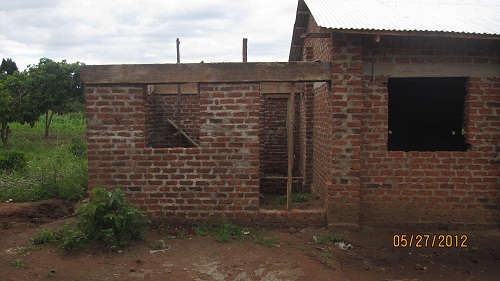
Ronald had to step me back a little, pointing out that the kids were still meeting in the temporary school shelter at the St. Paul’s location, and that the new school office, though it had walls, lacked both a floor and, well, a roof:

Oh, I thought, a roof, well, that does makes sense. Otherwise, the Head Teacher (who is like a Principal here in the U.S.) wouldn’t be able to get much done.

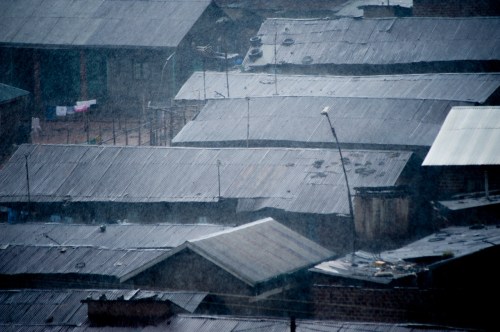
Here is a recent picture of what the rain can be like in Uganda, from a wonderful photographer, Will Boase (Mzungu Diaries), who kindly has allowed me to use his photo to demonstrate the need for a roof especially during the rainy season, which is now:

I’ve been involved with AROH for a few years now, and we have made great strides, one slow step at a time. It’s great to be able to contribute to the education and future of children in a different country. And sometimes, the first thing you need to do is get a roof over the head teacher’s head!

Thanks for stopping by,

Heather McC

PS. I’m contributing $10 today towards the office roof and floor/kitchen fund through the Facebook Causes app for AROH-USA. (It’s under the “General Donation Cause” if you want to contribute.)

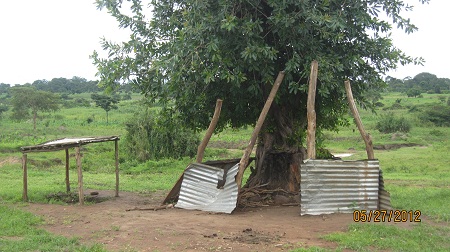
Here is the “kitchen”!

The (Very Large) Elephant in the Room

I mentioned in my first post on the topic of health that ideally, instead of measuring world health by rates of infant mortality, this would eventually decline so much that we could switch to a metric based on a country’s physical fitness, a function linked more to prosperity. Well, with infant mortality rates dropping, I seem to have gotten my wish, a lot sooner than I thought, but maybe not in the best way. (Always, always, be careful what you wish for!)

The World Health Organization (WHO) recently released, for the first time, global figures for all 194 member countries of the UN on the percentage of men and women with high blood pressure, and with raised blood sugar levels, a symptom of diabetes. What the figures clearly showed is the spread of chronic diseases such as heart disease from developed nations to poorer regions, as lifestyles and diets change. Even if you are aware of the problem in the U.S. (Amazingly, a lot of people are not — read this if you are not convinced!) you will probably be a bit shocked at the speed at which obesity and all its related diseases (diabetes, heart disease, high blood pressure, etc…) is literally spreading across the globe.

Some highlights from this article from Reuters:

  • One in three adults worldwide has raised blood pressure and the condition affects almost half the adult population in some countries in Africa;
  • One in 10 adults worldwide has diabetes, an illness that costs billions of dollars to treat and puts sufferers at risk of heart disease, kidney failure and blindness; up to a third of the population in some Pacific Island countries have the condition;
  • Rates of obesity have doubled in every region of the world between 1980 and 2008; and half a billion people – or 12 percent of the world’s population – are considered obese.

The medical community is working hard to address this epidemic. (Yes, it’s an epidemic. Ironically, people worry far more about the next super-virus or terrorist attack than the thing that is killing more of us than ever before and is right in front of our faces, stacked high on a plate.) However, although the idea of a “magic pill” is appealing, what the doctors are actually saying, screaming, yelling as loud as they can, is that there’s really only one way out: better diet and exercise.

The obesity/diabetes/heart disease epidemic is actually a challenge to our essential human nature: eat as much as you can and everything will be okay. We need to overcome that and it’s not easy.

But it doesn’t have to be overwhelming. Actually, there’s one really easy thing you can do today, right now: just walk! Just take a few extra steps. That’s all. If lots of people took those few extra steps, added up, we might have a shot at beating this. Let’s give ourselves that chance!

Thanks for stopping by,

Heather McC

PS. There are about a zillion ways to make exercising more fun — even more so with the advent of smart phone apps — so I won’t go into all of them here except to say that if I started with Fitocracy a few months ago and, though I’m just a newbie, I am finding that getting “awards” and “medals” for my slowly increasing fitness achievements, puts a smile on my face every day and makes it a little more fun! There are also a lot of very knowledgeable people on the forum for all sorts of questions and support.

PPS. I should also note that I work with Diabetes In Control, an online medical newsletter and website geared towards clinicians with the goal of keeping them current on the latest medical news related to diabetes.

Sudan’s Water Key

“So often times it happens, that we live our lives in chains,
And we never even know we have the key….” — “Already Gone,” The Eagles

This lyric sums up the recent revelation of massive and very deep water aquifers discovered under the northern part of Africa. (Huge’ water resource exists under Africa.) Specifically, the biggest source is under north-eastern Chad, throughout much of eastern and southern Libya, and under some areas of Darfur. (There is also a significant source under Mauritania and Western Sahara.)

In other words, droughts that the western Sudanese have been suffering through for years (only 57% of the population has access to improved water sources – CIA World Factbook), could have been largely mitigated by tapping into this resource. If the Khartoum government, instead of attacking, pillaging and raping both the land and the people, had invested in both people and sustainable land use, we could today be seeing a much greener vision of that area of the world. Instead, corruption, greed and extremism have prevailed, and we have a decimated landscape as well as population.

Darfur has fallen off the front page recently as the focus (as well as Sudan’s military) has shifted to the border with South Sudan, amid the north’s sudden frantic realization that the South has decided to take its petroleum toys and go play with other nicer, regional playmates, leaving Sudan without a significant source of previously reliable revenue.

But the problems in Darfur still persist. What can be done? The United Nations and African Union have some forces there, and some aid agencies have made progress, but there is still a tremendous amount of work to do. To truly effect change in the region will require a major political shift in those who control the country and that still seems a long ways off with President Omar al-Bashir firmly in charge despite the international pressures to alter that situation.

One organization that has been consistently working to raise awareness is Aid Still Required. They have been consistent in getting the word out about conditions in that inaccessible area. They also have a program, not yet launched, which could potentially help the people of Darfur tap into this vast water resource right under their feet. It’s called The Village Reforestation & Advancement Initiative (VRAI).

We’re unfortunately pretty far away from even beginning to implement such projects and there will be many, many projects of this type needed. But I will hold on to the hope that, like the untapped and powerful resource of this underground water,  the resource of empowered people in Darfur will eventually be released to rebuild their region and their lives.

Thanks for stopping by,

Heather McC

PS. If you want to see an excellent documentary of exactly what has happened there (with footage the journalist and ex-Marine risked his life to get), watch The Devil Came on Horseback. You can see an excerpt here on Youtube: The Devil Came on Horseback excerpt. (Warning: includes some very graphic and disturbing stuff.)

Self-reliance and Sustainable Change to End Hunger

I’ve watched this new video from The Hunger Project Australia several times now and am just so impressed each time about how clearly and concisely the basic principles of self-reliance, empowerment, and vision are explained. In 5 minutes, Dr. Badiul Majumdar, Country Director of THP Bangladesh, and the THP-Australia group, mostly business people, encapsulate the basics of how we really can end hunger, not just in Bangladesh, but world-wide.

I will be going to a presentation by Dr. Majumdar in June — please let me know if you are going too!

Thanks for stopping by!

Heather McC